FOR IMMEDIATE RELEASE
ADHA Calls for Dental Hygiene Self-Governance to Expand Access to Preventive Care
New white paper distinguishes self-regulation from self-governance and calls for authority over dental hygiene to align with the profession’s education, competence and accountability
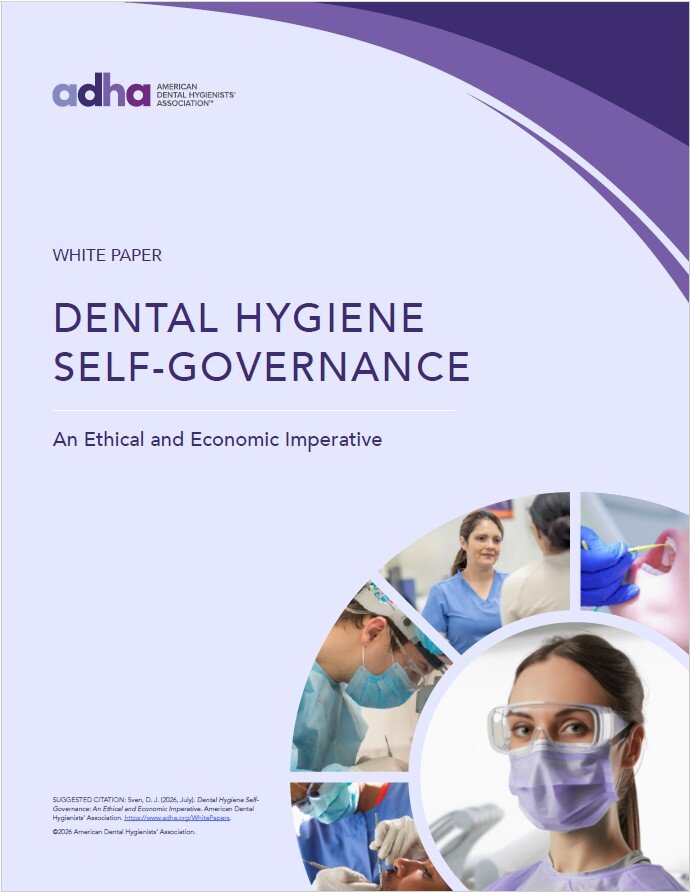
CHICAGO, Aug. 18, 2026—The American Dental Hygienists’ Association (ADHA) today released “Dental Hygiene Self-Governance: An Ethical and Economic Imperative,” a white paper that distinguishes professional self-governance from self-regulation and argues that preventive oral health policy cannot be fully modernized while dental hygiene remains governed by systems outside the profession. The paper was authored by Derik J. Sven, DHSc, MBA, MPH, RDH, CDT, FADHA, FAADH, an ADHA Fellow and president of the Virginia Dental Hygienists’ Association who worked with ADHA to develop the Dental Hygiene Modernization Act.
The paper draws a clear line between two ideas that are often used interchangeably. Self-regulation reflects authority delegated by the state to oversee members within an existing system. Self-governance reflects the inherent authority to define scope, standards, educational expectations and the systems through which care is delivered. Dental hygiene’s current model, the paper argues, grants the profession partial oversight but insufficient authority to shape the structures that determine access to preventive care.
Nursing offers a proven parallel. Through state boards of nursing and nurse practice acts, nursing built a regulatory foundation grounded in the profession itself, and full practice authority for nurse practitioners has since been associated with improved access to care in underserved and rural areas alongside outcomes comparable to physician-led care. Physical therapy has gone further still, reaching direct patient access in all 50 states in 2025. The white paper also situates the issue within antitrust law, noting that the U.S. Supreme Court’s decision in North Carolina State Board of Dental Examiners v. Federal Trade Commission underscored the risks of boards dominated by active market participants.
“Dental hygiene has operated under another profession’s authority for more than a century, even as the evidence for what hygienists can safely provide keeps growing,” said Dr. Sven. “Self-governance isn’t about independence for its own sake. It’s about aligning authority with the competence the profession already demonstrates.”
The white paper also examines the economics of dentist-controlled governance, citing evidence that scope-of-practice restrictions on hygienists raise the price of basic preventive services by roughly 12 percent, and that greater hygienist autonomy is associated with more preventive visits and fewer restorative needs, with effects most pronounced in dental provider shortage areas and low-income communities.
“Dental hygienists are preventive oral health experts, and the systems that govern our profession should reflect that expertise. Self-governance means aligning authority with education, competence, and accountability in service to the public. This white paper outlines a path to modernize dental hygiene governance, expand access to preventive care, and protect the public,” said ADHA President Jessica August, MSDH, RDH, CDA, FADHA.
The paper presents the Dental Hygiene Modernization Act framework as a measured model rather than a call for unrestricted autonomy, tying expanded authority to licensure, education, experience, continuing competence, and independent oversight.
Among its recommendations, the white paper calls on policymakers, regulators, and professional organizations to:
- Establish independent dental hygiene regulatory bodies with appropriate public representation
- Separate the dental and dental hygiene practice acts to reflect two distinct professions
- Align scope of practice with education and demonstrated competence
- Expand direct reimbursement pathways in Medicaid and commercial payer systems
- Replace mandatory supervision frameworks with collaborative practice models
The white paper is available for download at adha.org/whitepapers.
###
About the American Dental Hygienists’ Association
The American Dental Hygienists’ Association (ADHA) is the largest organization representing the professional interests of the more than 220,000 dental hygienists in the United States. Dental hygienists are preventive oral health professionals, licensed in dental hygiene, who provide educational, clinical and therapeutic services that support total health through the promotion of optimal oral health. The Journal of Dental Hygiene (JDH), published bi-monthly, is ADHA’s scientific journal and flagship publication. To learn more about the ADHA, dental hygiene or the link between oral health and general health, visit adha.org.
Media Contact
Bronwyn Barrera
ADHA
(312) 440-8911
[email protected]