We celebrated National Dental Hygiene Month (NDHM) all October long! ADHA® and Colgate® Oral Pharmaceuticals, Inc. teamed up once again and featured an incredible lineup of activities to celebrate and keep us inspired all month long. Links to the articles, podcast and recorded webinars are available below for a limited time. Enjoy!
This year’s theme is Everyday Extraordinary. While it’s easy to see the accomplishments and exceptional leadership of the select few, we often miss the incredible change that we can drive through our own daily work. With your dedication to patients, commitment to advancing oral health in your community, and upholding the highest standards of practice, you are Everyday Extraordinary.
We Celebrate NDHM with Community Service!
Everyday Extraordinary dental hygienists are making a different to improve access to care through volunteerism. The ADHA Institute for Oral Health Foundation, ADHA and Colgate’s Bright Smiles, Bright Futures® thank you for participating in this month-long volunteer drive. To continue to make a difference, please donate to the IOH Foundation to support research and grants that impact our profession and improve the oral health of our communities.
3-MINUTE NDHM SMART READS
NDHM: A time for career innovation
By Erin Haley-Hitz, MS, BSDH, RDH, FADHA, MAADH
Learn strategies to leverage the power of innovation plus 5 tips to help spark innovation in your dental hygiene career!
NDHM: Education is our calling
By Dawn Ann Dean, MSDH, RDH, CTTS, FADHA
Discover the critical role of education in the dental hygiene profession and the benefits you gain from lifelong learning.
NDHM: An Excellent time to volunteer
By Becky Smith, EdD, CRDH, FADHA
See how community and volunteerism fit hand in hand with the spirit of dental hygiene and are an easy way to give back to your community and your profession.
NDHM: Advocacy for your patients, your profession, and yourself
By Lancette VanGuilder, BS, RDH, PHEDH, CEAS, FADHA
Advocacy is the driving force behind a compassionate, patient-centered, and equitable health-care system. Learn tips to advocate for your patients, profession and self!
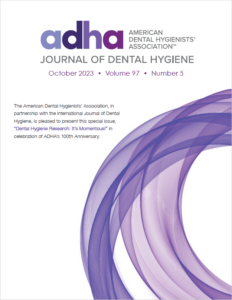
Special Celebratory Issue
Journal of Dental Hygiene, Vol. 97, Issue 5
In partnership with the International Journal of Dental Hygiene, ADHA is pleased to present this special issue “Dental Hygiene Research: It’s Momentous!” in celebration of ADHA’s 100th Anniversary. With an editorial co-written by the editors of both publications “100 Years of Dental Hygiene Research: Progress and Possibilities” and a table of contents bursting with 16 additional articles, this issue is a can’t-miss of the century and of National Dental Hygiene Month!
NDHM WEBINAR RECORDINGS

INNOVATION WEEK WEBINAR
Recorded October 4, 2023
Conflict: Stop the Blame Game and Bust Through to Solutions!
Recording Available • 1.5 CE • Free for ADHA Members
Presented by: Kelli Swanson Jaecks, MA, RDH, FADHA
How can you turn conflict into an opportunity for growth and find new ways forward? Learn clear communication strategies for tackling uncomfortable situations and difficult conversations with confidence and practice how to build consensus while navigating toward workable solutions. Your relationships inside and outside of work will be better for it!
View The Recording


EDUCATION WEEK WEBINAR
Recorded October 4, 2023
Driving Change to be Everyday Extraordinary: A Hygienist & Dentist Share Their Story
Recording Available • 1.0 CE • Free for ADHA Members
Co-presented by: Jessica Raymond-Allbritten, BASDH, CRDH & Ryan LePore, DMD
Real partnerships between dental hygienists and dentists are powerful! Share in the journey of this great team and learn how you can enhance patient care by building effective communication and collaboration across the entire office. Invite your dentist to join us, too!
View The Recording



EDUCATION WEEK WEBINAR
Recorded October 11, 2023
Increasing Preventive Dental Visits for Low-Income Youth
Recording Available • 1.0 CE • Free for ADHA Members
A discussion featuring:
Adam Barefoot, DMD, MPH • Katy Battani, RDH, MS • Tonia Tolbert-Moore Baillargeon, BSDH, RDH, NDHA President • Timothy Ricks, DMD, MPH, FICD, FACD, FPFA
Healthy People 2030 provides a set of national benchmarks to improve the nation’s health including 11 core oral health objectives. This webinar hosted by ADHA is presented in partnership with the National Dental Hygienists’ Association (NDHA), the Health Resources & Services Administration (HRSA), and the Healthy People 2030 Federal Oral Health Workgroup. Tune in to learn about the disparities in preventive services for low-income youth and activities you can help implement to address this critical issue.
View The Recording

EDUCATION WEEK WEBINAR
Recorded October 12, 2023
Science & Evidence for Product Innovation, Development and Clinical Usage
Recording Available • 1.0 CE • Free for ADHA Members
Presented by: Dr. Maria Ryan, DDS, PhD
Dr. Ryan is the Executive Vice President and Chief Clinical Officer at the Colgate-Palmolive Co. where she provides oversight and leadership to dental and dermal clinical organizations, knowledge management, scientific communications and the biosolutions team. In this hour she offers a look into the science behind Colgate products, as well as the extensive testing and clinical work conducted to deliver consumer preferred and professionally valued products.
View The Recording

COMMUNITY SERVICE WEEK PODCAST
Aired Monday, October 16, 2023
Everyday Extraordinary
Your Official ADHA Podcast, Episode 123 • FREE
Special Guest: Anaika Forbes-Grant, MSDH, BSDH, RDH
Your host, Matt Crespin, MPH, RDH, FADHA, welcomes Anaika Forbes-Grant, MSDH, BSDH, RDH, Associate Manager of Community Oral Health at Colgate. Learn more about the Bright Smiles, Bright Futures® program, how you can get involved in BSBF in your community, and what advice Anaika has for hygienists working daily to be extraordinary!
Listen Now!


ADVOCACY WEEK WEBINAR
Recorded October 24, 2023
Advocacy in Action: An Update on the Dentist and Dental Hygienist Compact
Recording Available • 1.0 CE • Free for ADHA Members
The Panel:
JoAnn Gurenlian, RDH, MS, PhD, AAFAAOM, FADHA • Matt Crespin, MPH, RDH, FADHA, ADHA Past President, 2019-2020 • Matt Shafer, Deputy Policy Director, National Center for Interstate Compacts, The Council of State Governments • Anthony J. Ziebert, DDS, MS, Senior Vice-president, Education and Professional Affairs, American Dental Association
Do you want more reciprocity among states and easier license portability? Have you heard about the Dentist and Dental Hygienist Compact? Our panel of experts discusses how this model can make it easier for you to practice in multiple states. We’ll cover:
- What the term dentist and dental hygienist compact means
- Which states have enacted the DDH compact and criteria required to apply
- Benefits of the DDH compact
- Separating DDH compact misinformation from the facts
Bring Out the Extraordinary in Patients’ Smiles with Colgate®
Colgate® Optic White® Professional In-Office Whitening
The future of in-office whitening is looking bright. Colgate® Optic White® Professional In-Office Whitening features a synergistic combination of a quick-dry whitening serum and a rechargeable LED device designed for dramatically whiter teeth in just 30 minutes when used as directed.
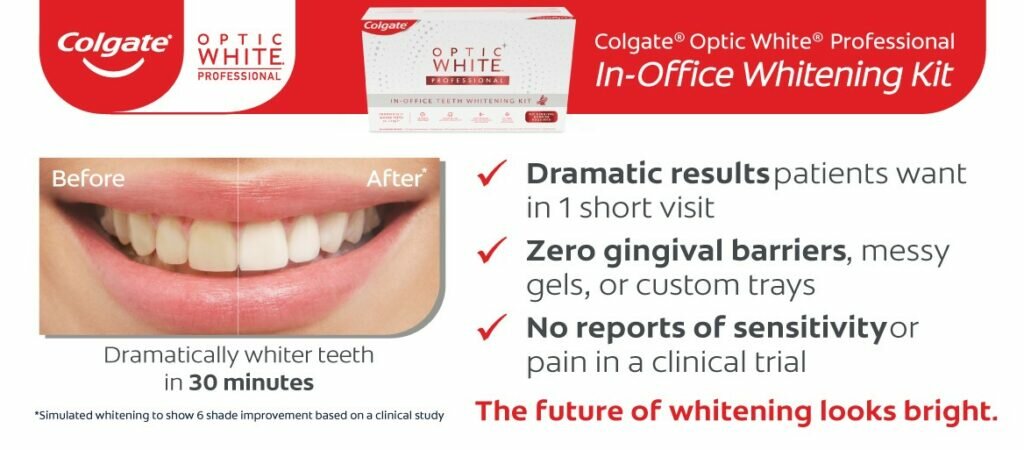
Discover how you can build your practice with Colgate® Optic White® Professional at bit.ly/OpticWhite.