by GoTu Marketing Team
May 18, 2026
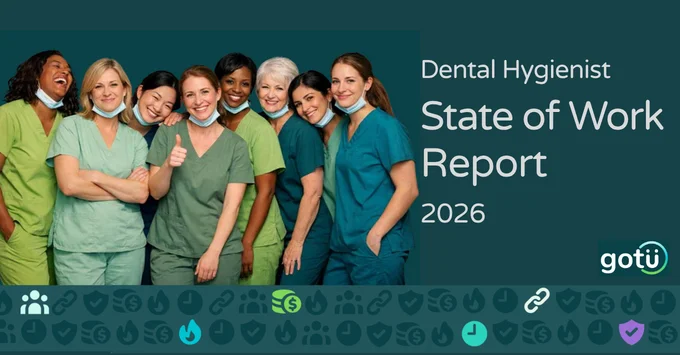
The dental hygiene profession has spoken, and this year, nearly 4,000 voices were behind the message. GoTu recently published the 2026 State of Work Report, its third annual look at the registered dental hygienist workforce.
Drawing from survey responses collected across all U.S. regions, the report is the most detailed examination of the RDH workforce the company has produced, covering compensation, burnout, clinical autonomy, flexible work, and the policy issues hygienists say will define the profession’s future.
The Workforce Is Experienced and Under Pressure
The hygiene workforce is more experienced than its age distribution might suggest. While the largest share of respondents falls between 25 and 44, experience levels vary widely. The largest career-length cohort is hygienists with more than 20 years in the field, meaning multiple generations are practicing side by side, each with different needs and different expectations of the profession.
That makes retention a challenge without a one-size-fits-all solution.
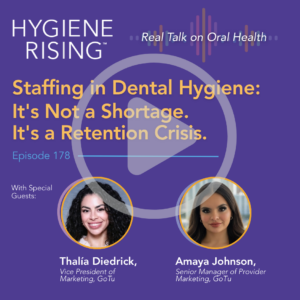
Listen to Ep. 178 of Hygiene Rising as GoTu’s Thalía Diedrick and Amaya Johnson unpack the 2026 State of Work Report.
77.7% of hygienist respondents plan to stay in the profession for ten or more years, a figure that sits five points below the 82.8% rate reported across all dental professions. The gap is meaningful: hygienists contend with higher burnout, more demanding physical conditions, and greater scope of practice frustrations than their colleagues in other dental roles. The pipeline of new hygienists remains active, with 10.7% of respondents in their first year of practice. But retaining experienced talent is where the pressure is building, and the data points clearly to what is driving it.
Compensation Is Better Than Average, But It’s Not Enough
Most hygienist respondents earn between $41 and $60 per hour, a rate that reflects the education and licensing requirements the profession demands. But the full picture is harder to dismiss. More than half of respondents (53.8%) did not receive a raise in the past two years. 44.7% have no employer-provided benefits at all. And 74.7% receive no bonus of any kind.
More than half of hygienist respondents have at least one financial dependent. When compensation stalls and benefits are absent, the effects don’t stay at the office.
Burnout Is Widespread, and It Has a Physical Root Cause
60.6% of hygienist respondents report having experienced burnout, and for 84% of them, it affects their day-to-day work on a recurring basis. What distinguishes hygienist burnout from the broader dental workforce is the leading driver: physical strain, cited by 71.9% of those who have experienced it. Sustained awkward positioning, repetitive fine-motor movements, and back-to-back patient schedules wear on the body in ways that accumulate over a career. Physical demand is also the top anticipated reason hygienists expect to eventually leave the field entirely.
Ergonomic practice environments and sustainable patient scheduling are not perks. They’re retention tools and the data makes that case.
The Dentist and Dental Hygienist Compact
The Dentist and Dental Hygienist Compact would allow hygienists to practice across state lines without undergoing full relicensure in each state, addressing the license portability issue that ranks as the number three most desired profession change among respondents (56.1%).
Among hygienist respondents familiar with the Compact, 89.6% say they support it. That is as close to professional consensus as survey data produces. And yet, 44.2% of respondents report zero familiarity with the Compact at all.
The gap between 89.6% support and 44.2% zero awareness isn’t an ideological problem. It’s an information problem, and it’s a solvable one. Hygienists who know what the Compact does, support it. The work is getting it in front of the ones who don’t yet know it exists.
What Hygienists Are Asking For
When asked what changes would most improve their profession, hygienist respondents named better benefits (71.6%), better pay (66.1%), license portability (56.1%), more respect (50.9%), and more autonomy (46.6%). The asks at the top of that list — portability, autonomy, and expanded duties — cannot be resolved through individual negotiation. They require legislative and regulatory action, and the profession’s advocacy infrastructure already exists for exactly this moment.
What Comes Next
GoTu releases the State of Work Report annually because the profession deserves a clear picture of where things stand. The 3,853 hygienists who responded to this year’s survey did not describe a profession in crisis. They described a profession under real and compounding pressure, led by people who are committed to the long haul and clear-eyed about what needs to change to make that sustainable.
Read the full 2026 State of Work Report at adha-sow.gotu.com.

____________________________________
GoTu is a pioneering, technology-driven workforce solution and skill-sharing marketplace serving the dental industry. The platform allows dental offices to contract directly with registered dental hygienists, dental assistants and associate dentists to fill both short-term and permanent positions. Launched in 2019 as a response to the growing staffing crisis in the dental industry, the platform has connected more than 35,000 dental offices with more than 100,000 dental professionals. Founders and childhood friends Cary Gahm and Edward Thomas, in collaboration with Debra Simmons, RDH, have grown the Miami-based business from a bootstrapped startup to an institutional, investor-backed powerhouse with 150+ dedicated team members. For more information, visit gotu.com.