ADHA Staff interviewed Diann Bomkamp, RDH, BSDH, CDHC, FADHA
August 20, 2026

Diann Bomkamp, RDH, BSDH, CDHC, FADHA
Diann Bomkamp has been a dental hygienist and ADHA member since 1969 and a leader in Missouri advocacy since 1983. She served as ADHA President from 2008 to 2009 and has spent decades working to protect the profession in her home state. On May 14, 2026, the Missouri Dental Board voted 4 to 3 to move forward with a proposed rule creating a Periodontal EFDA – a dental assistant permitted to perform supragingival scaling and comprehensive periodontal charting. We asked Diann to explain what the vote means, where the rule stands now and why hygienists everywhere should be paying attention.
INSIDE THE FIGHT
How did you first get involved in this issue in Missouri, and what has kept you in the fight?
I have been involved in advocacy with MDHA since 1983 and served as Legislative Chairperson for many years. I have seen many attempts to compromise our profession. MDHA faced scaling assistant bills in 2004, 2005 and 2018, so this issue is not new to Missouri. It was first resolved by adding two more distance education dental hygiene programs in rural areas of the state.
I have stayed in the fight because I think highly of our profession and the education we have all worked hard to attain. I also worry about the kind of care the public might receive and come to accept as good care when it is actually incomplete. We know better, and it is a professional responsibility to me to keep working on this issue until all efforts have been exhausted. Our patients deserve the best.
The Missouri Dental Board voted 4 to 3 on May 14 to move forward with the proposed rule. For hygienists outside Missouri who have not followed this closely, what changed with that vote, and where does the proposal stand now?
We were not in the closed session held before the May 14 meeting, but the vote itself was public. Two members who previously supported the OPA-EFDA Pilot Project did not vote to sustain it, along with the consumer member. Four others supported it, including the dental hygienist member of the Board.
Three of the members who voted to advance the rule had been appointed to the Board only months earlier, and two of them had ties to the pilot project or its training sites. Before the vote, they were asked to recuse themselves. On the record, in open session, they acknowledged the conflict-of-interest concerns and declined, choosing to remain voting members. The rule then passed on a roll call vote.
The proposed rule is actually more permissive than the training allowed under the OPA-EFDA pilot. It only requires a board-approved course, so the training could be even less than the pilot required. It does not designate which patient populations may be treated, so all patients could be seen, not only those who are healthy or have reversible gingivitis. Only supragingival scaling would be allowed, and the rule does not say who is responsible for following up on subgingival scaling, even though an RDH or dentist had to provide that follow-up during the pilot. In several ways this rule is worse than the pilot it would replace.
The proposed rule has been sent to the Missouri Governor’s office for approval to move forward and be printed in the Missouri Register, the publication where all state rules appear for public comment. As of July 31, 2026 , it had not been approved nor printed. The earliest it could appear is September, 2026. We are hopeful the Governor’s office will decline to move it forward, both because of the Board’s lack of statutory authority to create this rule and because the rule does not serve the public.
WHAT THE RULE WOULD ALLOW
The proposed rule would allow a dental assistant to perform comprehensive periodontal charting. Can you explain what that actually involves, and why it matters?
This proposal allows not only supragingival scaling but also comprehensive periodontal charting. A Periodontal EFDA would not have the background nor the ability to understand how all of these findings relate to one another, which is exactly what a proper evaluation of a patient’s periodontal and general health requires. It takes more education and supervised clinical experience to do that well. You have to understand the why behind each step.
A comprehensive periodontal charting involves many assessments, including:
- Probing depth: the distance from the gumline to the bottom of the pocket. Healthy measurements are 1 to 3 mm; depths of 4 mm or more indicate inflammation or potential bone loss.
- Bleeding on probing (BOP): healthy gums do not bleed. Bleeding when probed is a primary indicator of gingivitis or active periodontal disease.
- Suppuration: discharge of pus that indicates infection.
- Gingival recession: the amount of root surface exposed as gum tissue recedes.
- Clinical attachment level (CAL): the distance from the cementoenamel junction to the base of the pocket, providing an accurate measure of long-term tissue support and bone loss.
- Furcation involvement: bone loss between the roots of multi-rooted teeth such as molars.
- Tooth loss: loss attributable to periodontal disease.
- Tooth mobility: how loosely a tooth is anchored in its socket, typically graded on a numerical scale.
- Fremitus: palpable movement of a tooth when the upper and lower teeth come together.
- Biofilm and calculus: the presence of soft bacterial buildup and hardened tartar.
- Gingival tissue changes: color, size, shape, surface texture and position, which can signal disease.
- Radiographic evaluation: bone height and bone loss for grading and staging.
- Staging and grading of periodontal disease: a complex assessment that is challenging even for dentists and hygienists.
- Risk factors: smoking, diabetes and A1C, which affect the grading and progression of disease.
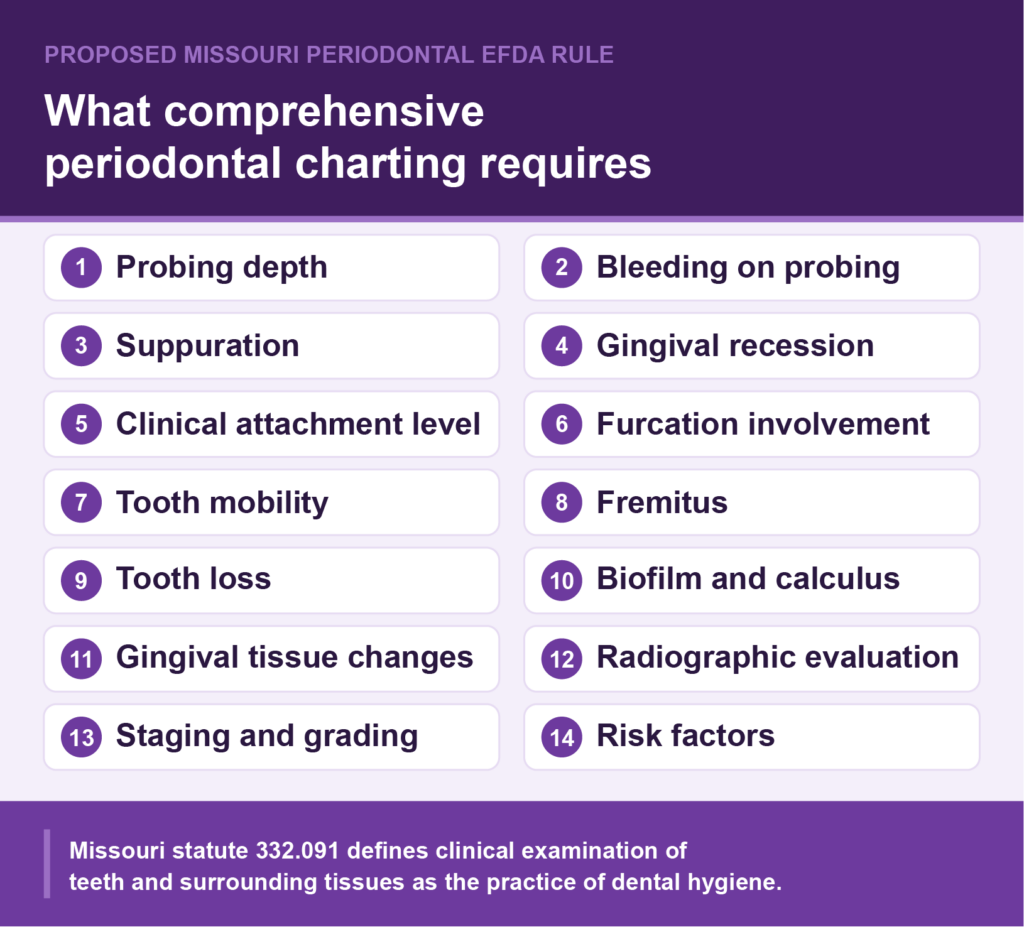 Comprehensive periodontal charting requires 14 interrelated clinical assessments.
MDHA’s position is that the Board does not have the statutory authority to create this position by rule without the legislature acting. What is that argument in plain language, why does the process matter as much as the outcome?
The process matters because our laws are based on what the Missouri legislature says, not on how anyone chooses to interpret them. The OPA-EFDA Pilot Project was given specific parameters, including an expiration date of August 28, 2026. The Board does not have the authority to extend a program the legislature authorized with a built-in end date. It cannot simply allow it to continue.
Missouri statute also allows dental hygienists, as licensed health professionals, to remove hard and soft deposits from the teeth. The current statute allows dental assistants to polish teeth, but not to scale. The Board does not have the legal power to permit more once the pilot has expired. That would require a change made by Missouri legislators.
WHAT THE EVIDENCE SHOWS
What did the OPA pilot project evaluation actually find? A lot has been said about it, and we want readers to understand what the evidence does and does not show.
The pilot project did not meet any of its three objectives.
There were several design weaknesses. The project relied on subjective patient satisfaction scores from a Likert scale to judge outcomes, and used Likert scales completed by supervising instructors, with undisclosed criteria, to grade the OPA-EFDAs. Neither is a valid way to evaluate patient outcomes. The patient types and the procedures performed were unknown; the pilot reported only that there were 1,626 visits. Results from just the three best-performing clinics were highlighted out of the seven sites.
The pilot’s own final report stated that the data did not demonstrate a significant increase in clinic capacity or improved access for more serious periodontal patients, because the design artificially limited how the OPA-EFDAs were deployed. That admission means Objectives 1, 2 and 3 were not met.
Throughout the process, MDHA was concerned about a lack of transparency around whether the study had an Institutional Review Board number. It was not disclosed in the interim reports and was documented only in the final reports, which identified a commercial IRB, BeyondBound. An OHRP registration confirms only that a company has submitted an assurance of compliance with federal human subject regulations. It does not certify scientific rigor, cure conflicts of interest in study design, or authorize the Board to make rules based on the study’s conclusions.
The reporting deadline to the Board and the legislature was December 31, 2025. It was puzzling to then see a second report in March 2026, created with input from the ADA Health Policy Institute, that presented different data and reached more favorable conclusions than the December final report. Either way, none of the three objectives was met. That was admitted plainly in the December report and addressed less directly in the March version, which removed many of the subjective comments.
WHY IT MATTERS EVERYWHERE
What outcome are you working toward?
MDHA is first trying to stop the proposed rule using our newly retained attorney. If the rule moves forward, there may be an intense and expensive legal battle ahead. If MDHA prevails, we will then need to work even more closely with our legislators, because the proposed rule will likely return as a bill sought by the Missouri Dental Association in the 2027 legislative session. MDHA has been educating legislators for many months in preparation.
Why should a dental hygienist in Ohio or Oregon or Florida care about what happens in Missouri?
What happens in one state affects each of us individually and collectively. As our profession is compromised, so is patient care. As one state falls, another becomes vulnerable. Accredited dental hygiene education should mean something, and our profession should be advancing, not eroding.
What can hygienists across the country do to help right now?
Right now, all of us have to stay aware of what is happening in our own states. Every state needs to understand its workforce data, track what is happening to our numbers, and come up with realistic solutions. My hope is that more hygienists will see the value of ADHA and their state associations and work with us to inform patients, dental professionals, legislators and policymakers about the problems with the OPA-EFDA .
I hope we can all work together to make lemonade from these lemons.
Learn more
- The May 14, 2026 open session of the Missouri Dental Board is available in the Board’s public meeting record.
- Comprehensive Evaluation of the Missouri OPA-EFDA Pilot: https://www.missouridha.org/_files/ugd/f8fcc3_59443cdbae8843c09dda27673fa2e4d5.pdf
- Diann’s November 2025 Hygienist Hub article: https://www.adha.org/hygienist-hub/missouri-opa-pilot-project-threatens-patient-safety/
____________________________________
 Diann Bomkamp, RDH, BSDH, CDHC, FADHA, has been a dental hygienist and ADHA member since 1970. As a long-time member of the ADHA, Diann has served various leadership and mentorship roles on regional and national levels. Regionally, she served in the Greater St. Louis Dental Hygienists’ Association, MDHA and the Missouri Hy-PAC. Nationally, she has served on a number of ADHA committees, as District VIII Trustee and as ADHA President 2008-2009. Diann is a strong advocate for Missouri dental hygienists. She instills the value of professionalism, mentorship, integrity, commitment, and service. Diann has worked tirelessly to protect, promote, and advance the profession of dental hygiene in the State of Missouri.