What Is an Oral Preventive Assistant (OPA)?
An Oral Preventive Assistant (OPA) is an expanded-function dental assistant role that has been proposed in some states as a way to address dental workforce shortages and access-to-care challenges. In many proposals, OPAs—often with minimal additional training—would be allowed to perform select dental hygiene procedures, including supragingival scaling and periodontal probing.
Although this model is presented as a solution to access problems, allowing unlicensed and under-trained individuals to perform preventive dental procedures raises serious concerns about patient safety, quality of care, and public health.
Why Training and Licensure Matter
ADHA defines a dental hygienist as a primary care oral health professional who has graduated from an accredited dental hygiene program within an institution of higher education and is licensed in dental hygiene to provide educational, assessment, research, administrative, diagnostic, preventive, and therapeutic services that support overall health through the promotion of optimal oral health.
ADHA maintains that scaling procedures require advanced instrumentation, assessment, and critical thinking skills, and should be performed only by licensed dental hygienists, licensed dental therapists, or licensed dentists who have completed this advanced education at a Commission on Dental Accreditation (CODA)-accredited institution.
Where Did the OPA Model Come From?
The OPA concept originated with the American Legislative Exchange Council (ALEC) through the Dental Access Model Act (DAMA), a model policy designed to encourage states to allow dental assistants to perform scaling and other preventive procedures.
read ADHA’s position statement on the Dental Access Model Act here
SEE THE DAMA MODEL POLICY HERE
Missouri Pilot Program
The concept was later expanded through a pilot program in Missouri, where OPAs were permitted to provide limited preventive services under direct supervision. The pilot was intended to demonstrate that OPAs could improve access to preventive care and reduce workforce strain. However, the interim findings and final report failed to support those goals.
The study reported no meaningful measurement of patient health outcomes, which is essential when evaluating the quality and safety of care. Many participants were classified as “healthy” despite known risk factors, and patients with gingivitis were not consistently evaluated to confirm that disease had resolved. Clinics showed little to no difference in patient volume or services delivered when OPAs were introduced and no improvement in health outcomes.
Although patient satisfaction scores were high, these ratings reflected interpersonal experience rather than clinical quality. The study also raised concerns about methodology and potential bias. It was evaluated internally, not registered as a clinical trial, and lacked independent external review. Together, these limitations make it impossible to conclude that OPAs improve access, efficiency, or patient health.
Why This Matters for Patients
Preventive dental care involves far more than routine plaque removal. It requires careful assessment of gingival health, identification of early disease, recognition of systemic risk factors, and development of individualized care plans. These responsibilities depend on advanced education, training, and clinical judgment.
When preventive services are delivered by individuals without comprehensive licensure and training, important signs of disease may be missed, treatment may be incomplete, and patients may face delayed diagnoses and worsening oral and systemic health. Protecting patient safety depends on care being delivered by qualified, accountable professionals.
Proven, Safer Solutions
Evidence-based solutions already exist to address workforce challenges and improve access to care. Allowing licensed dental hygienists to practice at the top of their education and training, expanding their role in community and public health settings, and removing unnecessary administrative barriers are proven approaches that protect patient safety while increasing access.
These strategies rely on professionals who are fully trained, licensed, and regulated, ensuring high-quality care without introducing untested provider models.
View ADHA’s White Papers on access to care and self-regulation
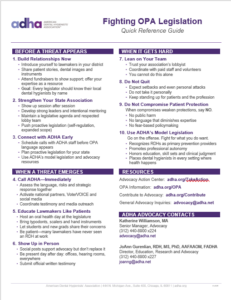
Download this guide with tips on fighting OPA legislation effectively in your state.
Our Position
The American Dental Hygienists’ Association strongly opposes the OPA model. Policymakers should reject proposals that allow unlicensed individuals to perform dental hygiene procedures and instead focus on solutions that prioritize patient safety, quality of care, and long-term public health.
Access to care should never come at the expense of patient health.