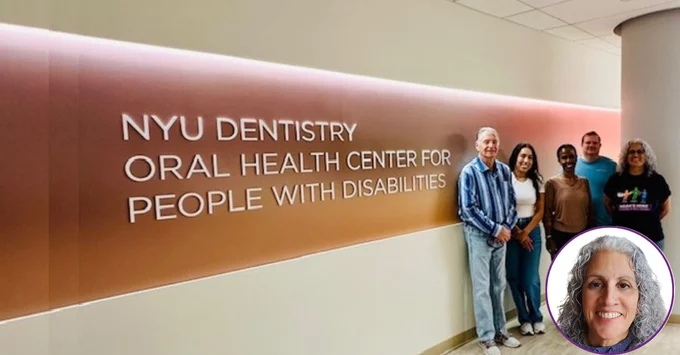
By Alicia Azimipour, RDH, BSPH
March 25, 2026
The morning of March 11, I was sitting in the audience at the Cordell Hull Building with my fingers crossed. The Senate Energy, Agriculture and Natural Resources Committee was reconvening that morning to take up Tennessee Senate Bill 162 (SB 162)1, and I had been there for every step of this fight.
No testimony was allowed that day. This was a continuation from the week prior, which meant the only person permitted to address the committee was the bill’s sponsor. For nearly five minutes, Sen. Joey Hensley stood at the front of the room and made his case, rebutting our opposition testimony from the week prior, with no one able to respond.
I sat and counted on my fingers. Left hand, right hand, running the numbers before the secretary called the roll.
Last year, a similar bill failed 6–3. I knew this committee. I hoped I could count on the outcome. When the final vote came, I let out a breath. Five to four.
One vote closer than last year — not a comfortable win. This was a warning.
SB 162, a measure that would have prohibited every public water system operator in the state from adding fluoride to the water supply, was dead. For now.
Six million people
To understand what was at stake, first you have to understand the scale of what was being decided. Tennessee does not mandate community water fluoridation; that decision is left to local governments. But roughly 88% of Tennesseans currently served by community water systems, about six million people, receive fluoridated water.2 This bill would have ended that statewide, with no exceptions and no local opt-out.
Conveniently, the bill’s sponsors never used the term “community water fluoridation.” Instead, they called it “adding fluoride to the water,” stripping away the public health context and making it easier to frame as a matter of personal choice rather than disease prevention.
Before the vote, there was testimony
The week prior, on March 4, the same committee had convened for a full hearing where both sides gave testimony. I was there with our lobbyist and Dr. Leon Stanislav, a past president of the Tennessee Dental Association and one of the most experienced community water fluoridation advocates in the country. He and I testified in opposition to SB 162.
On the other side, three witnesses testified in favor of the ban. A holistic dentist from Louisville, Kentucky; a Tennessee scientist connected to fluoride studies out of California; and a compliance controller who had previously worked in Tennessee but now lives and works in Mississippi.
The last witness made a claim that stayed with me. He testified that the type of fluoride added to community water supplies carries a skull-and-crossbones hazard label. After looking it up, I learned that the fluorosilicic acid he referred to, the most common form of fluoride used in water treatment, does not carry that designation. Its hazard classification is corrosive. He misrepresented the safety data on the substance at the center of this debate. He lied.
After testimony concluded, Sen. Hensley rolled the bill, pulling it from a Senate vote that day.
The numbers don’t lie
A week later, we were back. Before the roll call, one committee member spoke up. Sen. Page Walley thanked Sen. Hensley for coming to his community and educating them. He noted that Lawrenceburg had already chosen to discontinue community water fluoridation. But instead of disputing the science, his argument was that local governments should decide for themselves, rather than receiving a state mandate.
It wasn’t the research that moved him. It was the principle of government overreach.
Sen. Jessie Seal voted in favor this time without comment or explanation. The margin tightened in a way none of us had expected. While the bill died with a 5-4 vote, I want to be clear about what that means. That was one less vote against the bill than last year. This bill did not die due to science. It died because of politics.
The part they left out
The IQ argument came up again. It always does. And like before, it was real research being deliberately misapplied to an audience that deserved better.
The National Toxicology Program published a monograph reviewing research on fluoride and IQ.3 While the claim is rooted in a real study, here is what that monograph actually says: “This review finds, with moderate confidence, that higher estimated fluoride exposures, such as drinking water fluoride concentrations that exceed the World Health Organization Guidelines of 1.5 mg/L, are consistently associated with lower IQ in children.”
The recommended level of fluoride in U.S. community water systems is 0.7 mg/L, less than half the threshold examined in those studies. The NTP monograph explicitly states it does not address whether fluoride at 0.7 mg/L affects IQ.
The studies being cited in testimony were conducted at exposure levels more than double what flows from American taps, primarily in countries outside the United States. That context is not a footnote. It is the whole point.
The cost of getting this wrong falls hardest on those who can least afford it. A 2025 study in JAMA Health Forum found that eliminating community water fluoridation would add more than 25 million decayed teeth over five years, at a cost of $9.8 billion, with the greatest harm falling on publicly insured and uninsured children.4
What 0.7 actually looks like
And yet dosage, the most basic question, was never once discussed in that hearing room. That matters more than almost anything else in this debate.
![At that [0.7mg/L] concentration, you would reach water toxicity long before you would reach fluoride toxicity.](https://www.adha.org/wp-content/uploads/2026/03/HH_TN_CWF_Quote_3-282x300.png)
Here is what 0.7 milligrams per liter actually looks like. It is the equivalent of one inch in 23 miles. One minute in 1,000 days. One cent in $14,000. These comparisons come from the ADA’s MouthHealthy resource,5 and they were part of a slide our state association brought to a legislative breakfast to help lawmakers visualize what they were actually debating.
At that concentration, you would reach water toxicity long before you would reach fluoride toxicity.
The bill died. The fight didn’t.
What died on March 11 was one bill. Five more are still moving and they take different approaches.
One would require public water system operators to obtain a certificate of analysis for any water containing fluoride and post it publicly alongside the material safety data sheet. Another would prohibit public water systems from adding fluoride entirely. A third, known as the Tennessee Fluoride-Free Water Act, would go even further, banning not just fluoridated tap water but bottled water with added fluoride as well.
The most advanced of the five recently passed the full Senate 26–5. One bill dying in committee is not a win when five more follow close behind.
The fight is happening at the federal level too. In February 2026, ADHA worked with Rep. Lois Frankel to introduce a resolution in the U.S. House urging states to maintain scientifically recommended fluoride levels in public drinking water.6
What you do next matters
I am a wife and a mother of two young children and I’m a practicing clinician. I know what it means to carve out time that doesn’t exist in a day that is already full. But the people making legislative decisions don’t stop because clinicians are busy. If the dental community had not been represented for testimony, there would have been no opposition. No one to counter the misinformation. No clinician in the room who sits chairside with the patients whose lives these decisions affect.
Dr. Stanislav and I were there because they need to see that we care about this, and that we’re not just sending a representative in our place.
Whether this is happening in your state right now or is coming — and it is coming — there are things you can do today.
- Know your state. Is community water fluoridation mandated where you live, or left to local governments? That answer shapes your strategy.
- Understand the science and be ready to counter the misrepresentations, especially on dosage. Show legislators what 0.7 mg/L actually looks like. Review the NTP Fluoride Monograph and the JAMA Health Forum study on the cost of fluoridation removal.
- Educate your patients. You have the trust and the platform, and most of them genuinely don’t know what is at stake. Find resources at adha.org/Fluoride.
- Show up. When there is a hearing in your state, be in that room. Provide testimony. Be heard.
- Use ADHA’s advocacy resources. Contact your legislators. Make sure they know clinicians are watching. adha.org/TakeAction
Decay is a disease. Community water fluoridation is disease prevention. And dental hygienists are the prevention specialists. This is our fight too, and the patients in our chairs are counting on us to show up for it.
What you can do right now
Take action on Tennessee’s remaining anti-CWF bills and stay informed on legislation in your state through ADHA’s advocacy action center at adha.org/TakeAction.
Read ADHA’s position statement on community water fluoridation at adha.org/Positions.
References
- Tennessee General Assembly. “SB0162 — 114th General Assembly.” Accessed March 2026. https://wapp.capitol.tn.gov/apps/BillInfo/Default?BillNumber=SB0162&ga=114.
- Tennessee Department of Health. “Community Water Fluoridation.” Accessed March 2026. https://www.tn.gov/health/health-program-areas/oralhealth/redirect—community-water-fluoridation.html.
- National Toxicology Program. NTP Monograph on the State of the Science Concerning Fluoride Exposure and Neurodevelopment and Cognition: A Systematic Review. NTP Monograph 08. Research Triangle Park, NC: National Toxicology Program, August 2024. https://ntp.niehs.nih.gov/whatwestudy/assessments/noncancer/completed/fluoride.
- Choi, Sung Eun, and Lisa Simon. “Projected Outcomes of Removing Fluoride From US Public Water Systems.” JAMA Health Forum 6, no. 5 (May 2, 2025): e251166. https://doi.org/10.1001/jamahealthforum.2025.1166.
- American Dental Association. “Fluoridation Facts.” MouthHealthy. Accessed March 2026. https://www.mouthhealthy.org/all-topics-a-z/fluoridation.
- U.S. Representative Lois Frankel. “Frankel Resolution Pushes Back on Florida Fluoride Ban.” Press release, February 27, 2026. https://frankel.house.gov/news/documentsingle.aspx?DocumentID=4969.
 Alicia Azimipour, RDH, BSPH, is a dental hygienist practicing in Nashville, Tennessee, where she works in both public health dentistry and general practice. She has been an ADHA member since her student days at Western Kentucky University, where she served as her program’s Student ADHA representative. She is currently serving her third year as Legislative Chair of the Tennessee Dental Hygienists’ Association and is the incoming TNDHA President.