By Lisa J. Rowley, MSDH, RDH, CDA, FADHA
February 6, 2026
The dental hygiene scope of practice in Oregon is one of the most expansive in the United States. But how did this happen?
Dental hygienists in Oregon can administer local anesthesia with general supervision (dentist not on premises), place and finish restorations with indirect supervision (dentist on premises), and purchase and administer epinephrine with no dentist supervision.
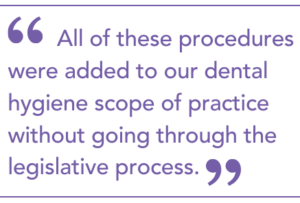
As of 2023 Oregon dental hygienists can initiate an intravenous (IV) infusion and perform a phlebotomy blood draw with indirect supervision. All of these procedures were added to our dental hygiene scope of practice without going through the legislative process.
State Regulation of Dental Hygiene Practice
In most states, dental hygiene practice is regulated by both the state legislature and a state board of dentistry (or other regulatory agency).
The state legislature regulates dental hygiene practice by adopting bills that become state laws. The state laws that regulate dental hygiene usually define the scope of practice for dental hygienists in that state. This scope of practice definition may be written along a continuum that goes from very specific to very general in terms of both allowable procedures and level of supervision required.
One example of a very specific definition for dental hygiene scope of practice would be “dental hygienists with indirect supervision are allowed to perform the following procedures: oral health assessment, home care instruction, oral prophylaxis, scaling and root planing, polishing and application of fluoride and sealants.” This definition is relatively restrictive because it implies that any procedure that is not on this list cannot be performed. The only way to expand this scope of practice is to introduce a bill that would amend the law to add additional procedures to the current list or a bill that would amend the law to make this definition more general.
An example of a somewhat general definition for dental hygiene scope of practice would be “the practice of dental hygiene includes, but is not limited to, educational, preventive and therapeutic services that the dental hygienist is competent to perform with general supervision.” This definition is very broad and open to interpretation as to what procedures are allowable.
A state board of dentistry regulates dental hygiene practice by adopting administrative rules and policy statements. Administrative rules (also called regulations or “regs”) are adopted through a formal rule making process that includes a public notice, public comment period and a board vote. Policy statements can be adopted by the board without this formal process.
Administrative rules are used by the state board of dentistry to interpret the law to make it more specific and enforceable. If a law has a somewhat general definition for dental hygiene scope of practice, the state board of dentistry may adopt administrative rules that further define the dental hygiene scope of practice. These administrative rules can expand or restrict dental hygiene scope of practice, but they cannot conflict with the law.
If the law prohibits dental hygienists from placing restorations, the state board of dentistry cannot adopt an administrative rule that would allow dental hygienists to place restorations because this administrative rule would conflict with the law.
If the law does not include any language that could be interpreted to prohibit dental hygienists from placing restorations, the state board of dentistry can adopt an administrative rule that allows dental hygienists to place restorations because this administrative rule would not conflict with the law.
State Legislature or State Board of Dentistry?
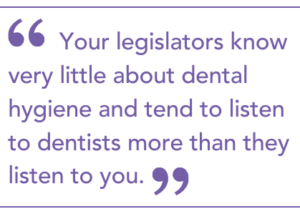
Expanding scope of practice through your state legislature is challenging for many reasons. Your state legislature deals with hundreds of bills each session and most of these bills are more important than yours. Your legislators know very little about dental hygiene and tend to listen to dentists more than they listen to you. If your legislature consists of 200 legislators, you will need 101 to vote in favor of your bill. The legislative process is purposefully slow and deliberate to help ensure that reasonable laws are adopted. You may need to hire a lobbyist to guide you through the legislative process. And it can take 3-5 years to successfully move your bill through the legislative process.
Expanding scope of practice through your state board of dentistry is a much easier process. Your board deals with a relatively small number of proposed administrative rules each year. Your board members know more about dental hygiene, although maybe not as much as you would like. If you have 12 board members you only need 7 to vote in favor of your proposed administrative rule. It can take less than 1 year to successfully move your proposed administrative rule through the rule making process.
How to Expand Scope of Practice without the Legislature
Your first step is to carefully review your state law to determine if the procedure that you want to add to your scope of practice is specifically prohibited by your law, or if the language in the law implies that the procedure cannot be done. If this is the case, you probably need to pursue this change through your state legislature.
If the procedure is not specifically prohibited by your law or if the procedure is not addressed in the law (law is “silent” on this issue), you may be able to add this procedure to your scope of practice through the administrative rule making process with your state board of dentistry. Remember that the administrative rule making process is much easier than moving a bill through your state legislature.
____________________________________
 Lisa J. Rowley, MSDH, RDH, CDA, FADHA, has dedicated her career to allied dental education and professional advocacy. Lisa was founding director of a BS degree dental hygiene program that prepares graduates to work as direct care providers for underserved patients in non-traditional settings. Lisa is the Advocacy Director for the Oregon Dental Hygienists’ Association and has worked in professional advocacy on the state and national level.