FOR IMMEDIATE RELEASE
ADHA Advocates for Dental Hygiene Self-Regulation to Strengthen Public Protection and Expand Access to Care
New white paper examines regulatory models and makes the case for professional self-regulation
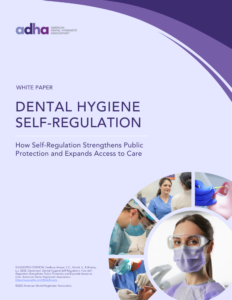
White paper is available for download at adha.org/WhitePapers.
CHICAGO, Dec. 22, 2025 – The American Dental Hygienists’ Association (ADHA) today released “Dental Hygiene Self-Regulation: How Self-Regulation Strengthens Public Protection and Expands Access to Care,” a white paper examining how professional self-regulation can empower dental hygienists to better serve the public and address barriers to oral healthcare.
The research reveals a stark reality: only two states — California and Washington — have achieved dental hygiene self-regulation. In the remaining 48 states, dental hygienists are regulated by state dental boards where they are outnumbered by dentist members, the same profession that employs most dental hygienists, creating an inherent conflict of interest that can restrict where and how dental hygienists practice.
“Dental hygienists are uniquely qualified to regulate their own education, licensure, practice standards, and discipline,” said Lancette VanGuilder, ADHA president. “Self-regulation isn’t about serving our own interests, it’s about removing conflicts of interest so that decisions about dental hygiene practice are made with the public’s health as the top priority.”
The white paper points to nursing as a proven model since 1903. For more than 120 years, nursing has functioned as a fully self-regulated healthcare profession. Through state Boards of Nursing and nurse practice acts, nursing has expanded its scope of practice and increased access to healthcare nationwide. Dental hygiene, which meets every other criterion that defines a profession, has yet to achieve this final step in most states.
“Dental hygiene fulfills the expectations of a profession — an established body of knowledge, rigorous education, a code of ethics, and commitment to public service — yet in the 21st century, we remain regulated by another profession,” said Dr. JoAnn Gurenlian, ADHA’s director of education, research and advocacy. “This white paper offers a roadmap for change and demonstrates how self-regulation benefits not just dental hygienists, but also the communities we serve.”
The white paper calls for dental hygienists to become informed about self-regulation, advocate for change with peers, patients, and policymakers, and collaborate with key stakeholders to advance self-governance in the public’s best interest.
The white paper was authored by Cynthia C. Gadbury-Amyot, RDH, MSDH, EdD; Sylvie Martel, RDH, DipHE; and Lisa J. Rowley, MSDH and is available for download at adha.org/whitepapers.
###
About the American Dental Hygienists’ Association
The American Dental Hygienists’ Association (ADHA) is the only organization representing the professional interests of the more than 220,000 dental hygienists in the United States. Dental hygienists are preventive oral health professionals, licensed in dental hygiene, who provide educational, clinical and therapeutic services that support total health through the promotion of optimal oral health. The Journal of Dental Hygiene (JDH), published bi-monthly, is ADHA’s scientific journal and flagship publication. To learn more about the ADHA, dental hygiene or the link between oral health and general health, visit www.adha.org.
ADHA Media Contact
Bronwyn Barrera, MBA
(312) 440-8911
[email protected]